
GRP Grating for Electrical Engineering & FRP Insulated Platforms
GRP grating and FRP grating are the default non-conductive decking for substations, switchgear rooms and high-voltage work areas. ZeAllgrate supplies dielectric fiberglass platforms, cabinet bases and arc-flash safe walking surfaces that protect maintenance personnel from step and touch potential. See our antistatic GRP grating for ESD-sensitive areas.
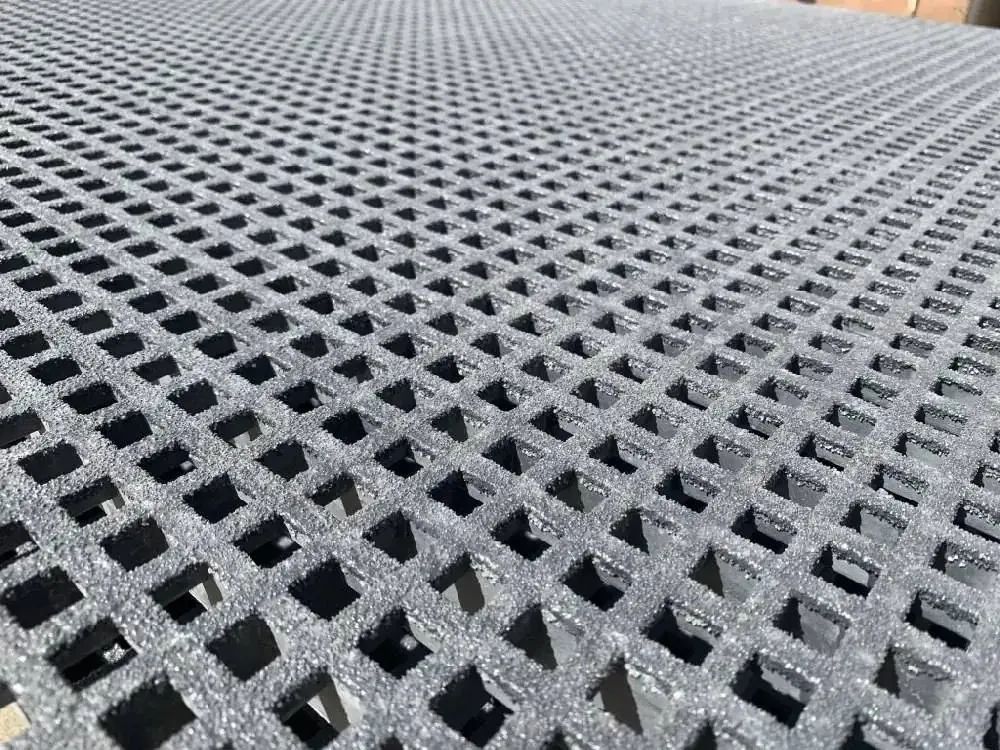
Insulated Platforms That Block Step & Touch Potential
In a substation or switchroom, a ground fault creates a voltage gradient across the floor. A worker standing on steel or concrete becomes a conductive path between points of different potential — step and touch voltage can exceed safe limits in milliseconds. GRP grating is a high-performance dielectric: volume resistivity above 10¹² Ω·cm, so an FRP grating floor physically breaks that circuit and keeps fault current away from the body. It is a passive, always-on safety layer that does not rely on PPE or procedure.
GRP grating also eliminates the hum and parasitic capacitance that metal decks introduce around high-voltage buswork, and it will not conduct across cable trenches or transformer oil drains. At 14 kg/m², an insulated FRP grating platform can be built as a freestanding lightweight structure on FRP supports — no earthing straps, no bonding, no galvanic corrosion at fixings.
- Dielectric >10¹² Ω·cm — blocks step and touch voltage
- Arc-flash safe — no secondary conductive splash
- Non-magnetic — no interference with buswork and CTs
- Anti-static option — surface resistance 10⁶–10⁹ Ω for ESD zones
Electrical-Grade GRP Grating Selection
Standard molded GRP grating is inherently insulating. For explosive or ESD areas specify the anti-static (dissipative) grade — controlled surface resistance rather than full insulation.
| Application | Grade | Surface resistance | Panel |
|---|---|---|---|
| Substation operating deck | Vinylester standard | >10¹² Ω·cm | #38 molded |
| Switchroom raised floor | Vinylester standard | >10¹² Ω·cm | #38 / #50 molded |
| Explosive / gas zone | Anti-static dissipative | 10⁶–10⁹ Ω | #38 molded |
| Control cabinet base plinth | Isophthalic standard | >10¹² Ω·cm | Covered / solid plate |
Dielectric strength tested per ASTM D149; typical value 10–15 kV/mm. We supply test reports with every batch.
Where FRP Grating Protects Electrical Workers
Substation decks
Insulated operating platforms over switchgear bays.
Switchroom floors
Raised FRP grating around LV/MV panels.
Cabinet plinths
Non-conductive bases isolating control cabinets.
Cable trench covers
Dielectric covers over HV cable runs.
Arc-flash zones
Non-sparking decks near arc-rated gear.
ESD / clean rooms
Dissipative GRP grating for sensitive electronics.
Arc-Flash Safety and Why Material Matters
An arc-flash event releases temperatures above 19,000 °C and explosive pressure waves. Steel decking around the switch not only conducts the fault but can shatter and launch molten metal. GRP grating does not conduct and does not melt into droplets; combined with its non-sparking nature it removes two secondary hazards from the incident. FRP grating is also unaffected by the ozone and sulfur dioxide produced by arcing, so the platform survives the event structurally.
For maintenance staff, the ergonomics matter too. A GRP grating insulated platform lets lineman stand to work without the fatigue of rubber mats that shift, tear or absorb oil. Panels clip together in a continuous, anti-slip walking surface that stays put for the life of the installation. See our antistatic GRP grating page for dissipative-grade specifications.
| Property | Steel / concrete floor | GRP / FRP insulated grating |
|---|---|---|
| Volume resistivity | Conductive | >10¹² Ω·cm |
| Dielectric strength | n/a | 10–15 kV/mm |
| Step voltage protection | Relies on mats / footwear | Passive, always-on |
| Weight | Heavy, fixed | 14 kg/m², relocatable |
Electrical GRP Grating FAQ
Is GRP grating a substitute for rubber insulating mats?
It is a superior permanent layer: continuous, anti-slip, and rated at >10¹² Ω·cm. Rubber mats still serve portable tool work, but a fixed FRP grating platform protects every worker who steps on it.
What is the difference between insulating and anti-static GRP grating?
Insulating grade (standard) is >10¹² Ω·cm for shock protection. Anti-static dissipative grade holds 10⁶–10⁹ Ω to bleed static in ESD or explosive atmospheres where full insulation could accumulate charge.
Can it be used under 110 kV switchgear?
Yes — vinylester GRP grating decks are specified around 66 kV, 110 kV and 220 kV substations worldwide. We supply ASTM D149 dielectric test reports and stamped drawings.
Does FRP grating attract lightning or static?
No. It is non-conductive and non-magnetic, so it does not become a strike receptor or accumulate damaging charge when properly bonded at the dissipative grade.
Need an insulated platform or arc-flash deck schedule?
Send us the voltage level and room layout — we return a dielectric take-off with grade and clip selection within 24 h.