Water & Wastewater FRP Grating Solutions
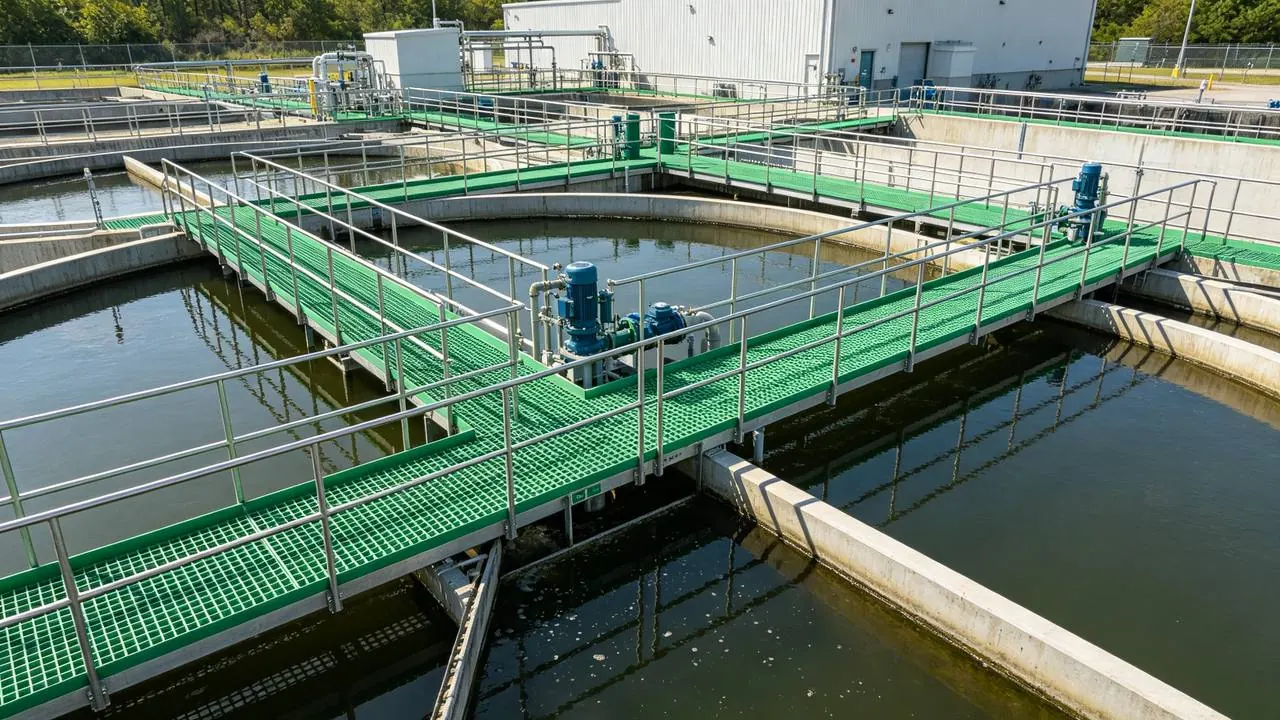
Why Water & Wastewater Needs FRP
Wastewater treatment plants are among the most corrosive industrial environments on earth. Hydrogen sulfide from anaerobic digestion attacks steel at alarming rates, and wet/dry cycling accelerates every material failure. FRP is now the de-facto standard for WWTP walkways and covers.- H₂S gas corrodes steel walkways within years
- Constant moisture and chemical exposure
- Clarifier and aeration tank access over water
- Potable water contact requiring NSF-compliant resins
ZeAllgrate Solutions for Water & Wastewater
ZeAllgrate molded grating, basin covers and handrail systems are engineered for the WWTP environment — with resin systems for H₂S service, anti-slip surfaces for wet walking, and covers that seal odors while carrying maintenance loads.
Typical Applications
Clarifier walkways
Aeration basin covers
Channel & flume covers
Chemical feed platforms
Filter building access
Sludge handling areas
Project Gallery
Real ZeAllgrate FRP grating products and installations in service across this industry.

Anti-slip FRP stair and walkway over a treatment channel
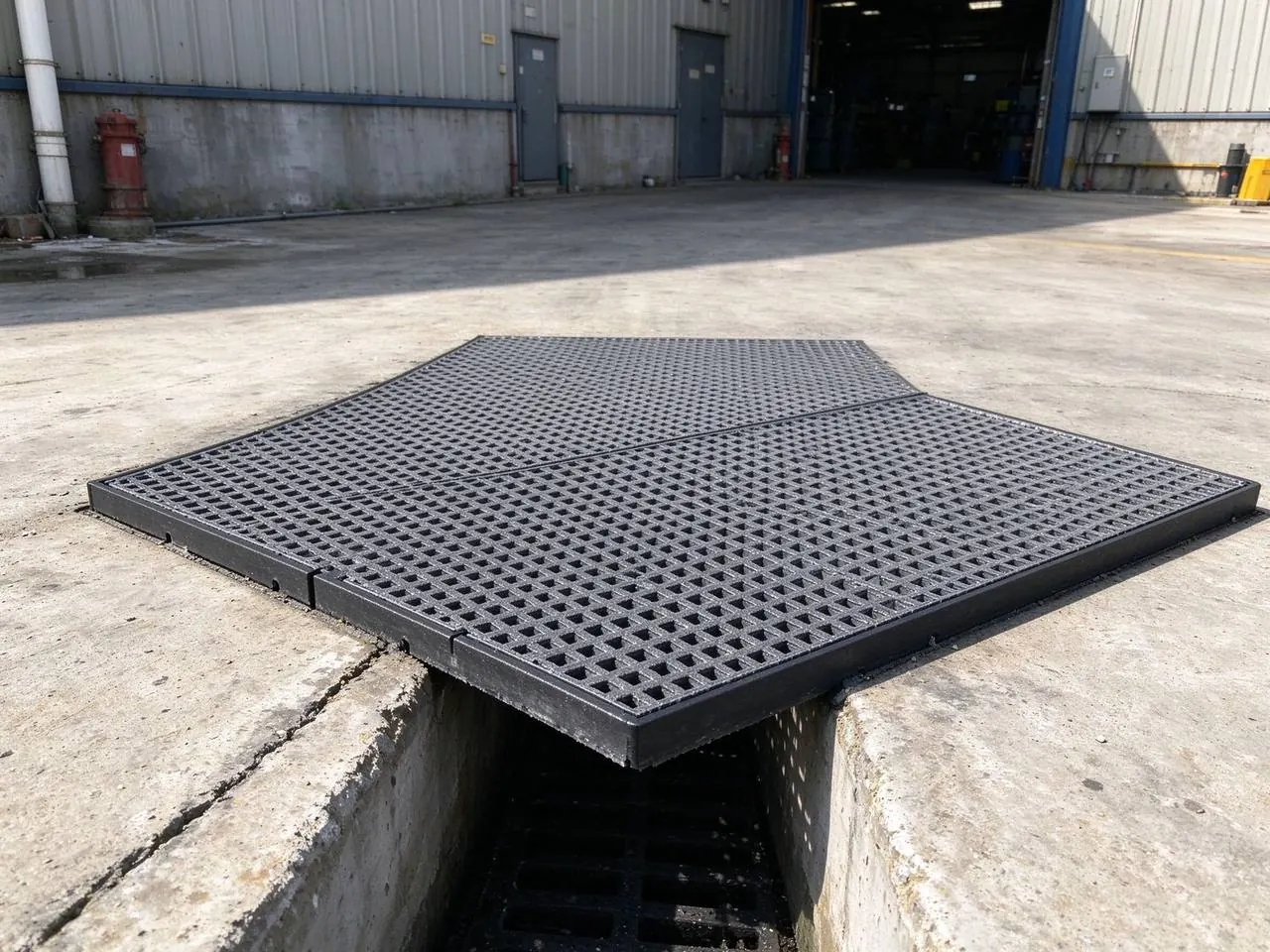
FRP solid trench cover for odor sealing in a WWTP

Molded FRP walkway over clarifier tanks
Solutions for Every Process Area
Engineered FRP solutions mapped to each stage of your facility — from corrosive process zones to high-traffic access routes.
Molded grating and covers at headworks resisting grit and chemical attack.
Anti-slip walkways over aeration tanks in permanent humidity.
H₂S-resistant covers, baffles and access for sludge processing.
Corrosion-proof platforms for chlorine and chemical dosing areas.
Sub-floor and pit covers carrying maintenance loads while sealing odors.
Technical Specifications & Compliance
Application-specific engineering reference for Water & Wastewater — corrosion rating, load criteria, governing codes and the recommended ZeAllgrate configuration. Use this as the specification starting point; final design must be verified against certified load/span charts and the project's governing codes.
| Parameter | Specification for Water & Wastewater |
|---|---|
| Corrosion Level | High Hydrogen sulfide (H₂S) from anaerobic digestion, wet/dry cycling and process chemicals attack steel within years. |
| Typical Load Requirements | Clarifier/aeration walkways 50 psf (2.4 kN/m²) pedestrian; trench & basin covers 75–100 psf (3.6–4.8 kN/m²) including maintenance wheelbarrows; concentrated load check for filter-cart change-out. |
| Applicable Standards & Regulations | OSHA 1910.23 & 1910.29, ISO 14122-1..4, AWWA (water/wastewater practice), NSF/ANSI 61 (potable-water contact resins), AWWARF, local health department potable-water approval. |
| Recommended Resin System | ZeAll VE for H₂S-rich digester & biosolids areas; ZeAll ISO for general plant walkways; ZeAll FDA (food/potable grade) where NSF 61 potable-water contact is required. |
| Recommended Grating Type | Molded 38.1 mm grit-top walkways over basins; Mini-Mesh covers for odor/seal and small-part exclusion; Pultruded I4015 for long-span clarifier bridges. |
Resin systems: ZeAll VE (vinyl ester — severe corrosion), ZeAll ISO (isophthalic polyester — general service), ZeAll FDA (food/potable grade), ZeAll FR (extra flame-retardant), Phenolic (fire/smoke-critical). Grating types: Molded (bi-directional), Pultruded (long-span), Mini-Mesh (fine openings), HLC (high-load capacity).
Typical System Configuration
A cost-optimised isophthalic FRP walkway and cover package for a treatment plant — molded grating, handrail, perforated tank covers and duplex-aware fastener selection. Isophthalic polyester handles the H₂S and wet/dry cycling at lower cost than vinyl ester, with upgrade points only where chlorine or strong chemicals are present.
Component List
| Component | Product / Model | Material / Resin | Key Spec | Quantity / Ratio |
|---|---|---|---|---|
| Grating panels | ZeAllgrate Molded 38mm | ZeAll ISO, concave + grit-top in chemical areas | 38.1 mm thick, ~70% open | Clarifier / aeration walkways |
| Handrail system | ZeAll ISO tube handrail | ZeAll ISO tubes, SS304 fittings | 42.4 mm posts, mid-rail, toeboard | Perimeter and open edges |
| Covers | Perforated / solid covers | ZeAll ISO | Tank openings, odor & small-part control | Tank openings and channels |
| Clips & fasteners | G-type panel clips | SS304 (SS316 in chlorination areas) | Through-bolted | 2 clips per panel |
| Edge banding | FRP edge banding | ZeAll ISO, moisture-resistant | 3 mm protective trim | Panel perimeter |
Design Parameters Summary
| Design Parameter | Value for Water & Wastewater |
|---|---|
| Load rating | Pedestrian 3.0 kN/m² (~63 psf) |
| Span | 1.0 m panel span |
| Deflection limit | L/150 under design load |
| Resin selection rationale | Isophthalic (ZeAll ISO) for H₂S / moisture, cost-effective |
| Surface type | Concave for general walkways; grit-top for chemical dosing |
| Fastener material | SS304 standard; SS316 in chlorination areas |
Applicable Standards & Codes
- OSHA 1910.23 (ladders & walking-working surfaces)
- OSHA 1910.29 (guardrail systems)
- ISO 14122-1/-2/-3/-4 (permanent machinery access)
- ASTM C581 (chemical resistance of thermoset equipment)
- AWWA / AWWARF water & wastewater practice; NSF/ANSI 61 where potable contact applies
Wastewater plants are enormous, mostly mild-corrosion, wet environments — paying vinyl-ester prices across every walkway is poor value. Isophthalic polyester (ZeAll ISO) resists H₂S and perpetual wet/dry cycling well enough for the bulk of clarifier and aeration walkways, the concave top sheds liquid and cleans faster than grit, and fastener grade is stepped up to SS316 only at chlorination and strong-dosing points. The result is a plant-wide package that meets the corrosion duty without over-spending on atmospheric zones.
Water & Wastewater Service Requirements
| Condition | ZeAllgrate Response |
|---|---|
| H₂S & chlorine atmospheres | Corrosion-proof; resin matched to the atmosphere |
| UV exposure | UV-stabilised grades for open tanks |
| Wet slip risk | Grit-top on clarifier and channel decks |
| Chemical feed areas | Vinyl ester for coagulant / polymer contact |
Specification Guidance
Water and wastewater plants are the classic FRP proving ground: clarifier walkways, aeration basin covers and chemical feed platforms all live in wet, corrosive, UV-exposed service. Specify grit-top for the wet traffic, vinyl ester where chemicals contact the deck, UV-stabilised resin for the open exposure, and SS316 hardware throughout. The corrosion-proof construction removes the repaint and replacement cycle of steel in the same plant. The case library documents wastewater treatment installations.
Water and wastewater plants are the classic FRP proving ground: clarifier walkways, aeration basin covers and chemical feed platforms all live in wet, corrosive, UV-exposed service. FRP drainage grating channels surface runoff and process water to collection points while keeping walkways safe underfoot. Specify grit-top for the wet traffic, vinyl ester where chemicals contact the deck, UV-stabilised resin for the open exposure, and SS316 hardware throughout. The corrosion-proof construction removes the repaint and replacement cycle of steel in the same plant. The case library documents wastewater treatment installations.Go Deeper with the ZeAllgrate Knowledge Base
H₂S & Biogenic Acid: Why Isophthalic Fails in Headworks
Wastewater headworks are the worst service for FRP: H₂S gas oxidises on wet concrete to biogenic sulfuric acid (pH<2) within 1–3 years. Isophthalic polyester — economical in neutral water — hydrolyses under this attack and the panel swells, delaminates, and loses 60% of its flexural strength. We specify vinylester (bis-A epoxy) for any headworks, grit chamber, or primary clarifier cover.
| Process zone | Typical attack | Resin specified | Surface | Hardware |
|---|---|---|---|---|
| Bar screens / grit chamber | H₂S + biogenic acid | Vinylester | Concave-top (H₂S condensation) | SS316 |
| Primary / secondary clarifier cover | H₂S + grease | Vinylester | Grit-top, R12 | SS316, quick-release hinge |
| Sludge thickener | H₂S + warm humid air | Vinylester | Smooth gel-coat | SS316 |
| Effluent walkway (post-treatment) | Neutral water, wet | Isophthalic | Grit-top | SS304 acceptable |
Trench & Basin Covers: Load Classes
Wastewater plants specify FRP grating covers for odor control and worker access. We size by EN 124 load class:
| EN 124 class | Test load | Typical use | ZeAllgrate spec |
|---|---|---|---|
| A 15 | 15 kN | Pedestrian zones | 25 mm molded, iso |
| B 125 | 125 kN | Service vehicles | 38 mm vinylester molded |
| C 250 | 250 kN | Truck / lorry | 50 mm pultruded I-bar |
Covers are bolted with quick-release hinges (every 1.5 m) for odor-zone maintenance without lifting equipment. Molded GRP grating is preferred over pultruded in H₂S zones because the random glass distribution gives better corrosion margin than unidirectional roving.
Reference: German Municipal WWTP
A 12,000 m² German municipal WWTP replaced steel walkways and covers after 6 years of corrosion failures. We supplied:
- 12,000 m² of 38 mm vinylester molded panels (concave-top for headworks, grit-top for secondary).
- Quick-release hinged covers on every odor-controlled channel.
- SS316 G-clips at every support intersection; cut edges sealed with resin gel-coat.
Six years in: zero corrosion, zero clip failure, zero repaint. Compare to the prior steel installation which needed full replacement at year 6.

Common Failure Modes in Wastewater FRP
Wastewater is a corrosive wet environment — but failures are rarely about the resin. They are about the details:
| Failure mode | Root cause | ZeAllgrate prevention |
|---|---|---|
| Resin swelling in headworks | Isophthalic polyester under biogenic H₂SO₄ | Vinylester (bis-A epoxy) for any H₂S zone |
| Odour escape from covers | Covers bolted solid; no access for maintenance | Quick-release hinged covers every 1.5 m; gas-escape hatches as spec'd |
| Slip on wet walkway | Smooth or grit-worn surface | Grit-top R12 minimum; concave-top for H₂S condensation zones |
| Clip rust streaks | SS304 clips under H₂S + moisture | SS316 in any headworks / primary clarifier zone |
Sizing Trench Covers: A Worked Example
A 600 mm wide grit-channel trench in a municipal WWTP needs a cover that a maintenance worker can lift by hand (max 25 kg per EN 13001) but a service truck can drive over. Here is how we size it:
- Span: 600 mm between supports. Standard molded panels on 600 mm span carry 5 kN/m² uniformly.
- Point load: service truck wheel ≈ 25 kN per wheel. We move to 38 mm vinylester molded on 600 mm span, point load tested to 5 kN per ASTM E-1364 — the wheel load is spread over two panels.
- Hardware: SS316 quick-release lift-out handles; not bolted — maintenance needs access every 6 months for cleaning.
- Surface: grit-top R11. H₂S condensation is constant; smooth surface becomes a slip hazard.
If the trench is wider than 1.0 m, we move to pultruded bar-grid covers with SS316 lift-out handles. For vehicle-rated covers over 50 kN, we specify 50 mm pultruded I-bar on 1.0 m supports — contact engineering for a stamped chart.
Specification Checklist for Wastewater FRP
Wastewater covers and walkways fail when the spec treats the plant as one environment. Confirm every item:
- Process zone: headworks/grit, primary clarifier, secondary, sludge, effluent. Each has a different H₂S level and resin spec.
- H₂S exposure: any H₂S zone (headworks, primary) gets vinylester. Isophthalic only in post-treatment effluent.
- Cover load class: EN 124 A15 (pedestrian), B125 (service vehicle), C250 (truck). Specify the class per channel.
- Access frequency: quick-release hinged covers every 1.5 m where maintenance is frequent; bolted covers only where access is rare.
- Anti-slip: grit-top R11 minimum; concave-top for H₂S condensation zones.
- Hardware: SS316 in any headworks or primary clarifier zone; SS304 acceptable in effluent walkways.
- Odour control: gas-escape hatches, chemical injection ports, and access points — coordinate with the odour-control engineer.
Send the checklist to sales@zeallgrate.com. We return a stamped cover schedule within 48 hours.
FRP vs. Steel Covers in a WWTP: H₂S is the Decider
In a wastewater plant, the choice between steel and FRP covers is decided by one chemical: H₂S (hydrogen sulphide). Where steel covers fail within 5–8 years, vinylester FRP covers run 20+.
| Zone | Steel cover life | Vinylester FRP life |
|---|---|---|
| Headworks / grit (H₂S) | 5–8 years | 20+ years |
| Primary clarifier (H₂S + grease) | 8–10 years | 20+ years |
| Secondary (low H₂S) | 10–12 years | 20+ years |
| Effluent walkway (neutral) | 15 years | 25 years |
The 12,000 m² German WWTP reference replaced steel after 6 years — the vinylester FRP install has run zero corrosion, zero clip failure, zero repaint since.
Have a Water & Wastewater Project?
Send us your application and environment details — our engineers respond within 24 hours with a technical solution.
Why FRP Grating for Water & Wastewater?
FRP grating for water treatment: corrosion-resistant to wastewater chemicals, lightweight for tank access platforms. No rust, no maintenance.