Oil & Gas / Offshore FRP Grating Solutions
Why Oil & Gas / Offshore Needs FRP
Offshore platforms fight a triple enemy: saltwater spray, H₂S and extreme weight constraints. Every kilogram of topside steel costs money to install and maintain. Pultruded FRP grating is up to 75% lighter than steel and immune to saltwater corrosion.- Topside weight reduction is critical for offshore design
- Saltwater and H₂S corrosion of steel decks
- Electrically live areas needing non-conductive access
- Remote locations demanding zero-maintenance materials
ZeAllgrate Solutions for Oil & Gas / Offshore
ZeAllgrate pultruded grating and handrail systems deliver offshore-grade performance: 70% glass content for stiffness, fire-retardant resin options, and complete systems that bolt together without welding.
Typical Applications
Offshore walkways & decks
Pipe racks & cable trays
Platform stair & ladder access
Process module platforms
Helideck access
FPSO topside structures
Project Gallery
Real ZeAllgrate FRP grating products and installations in service across this industry.

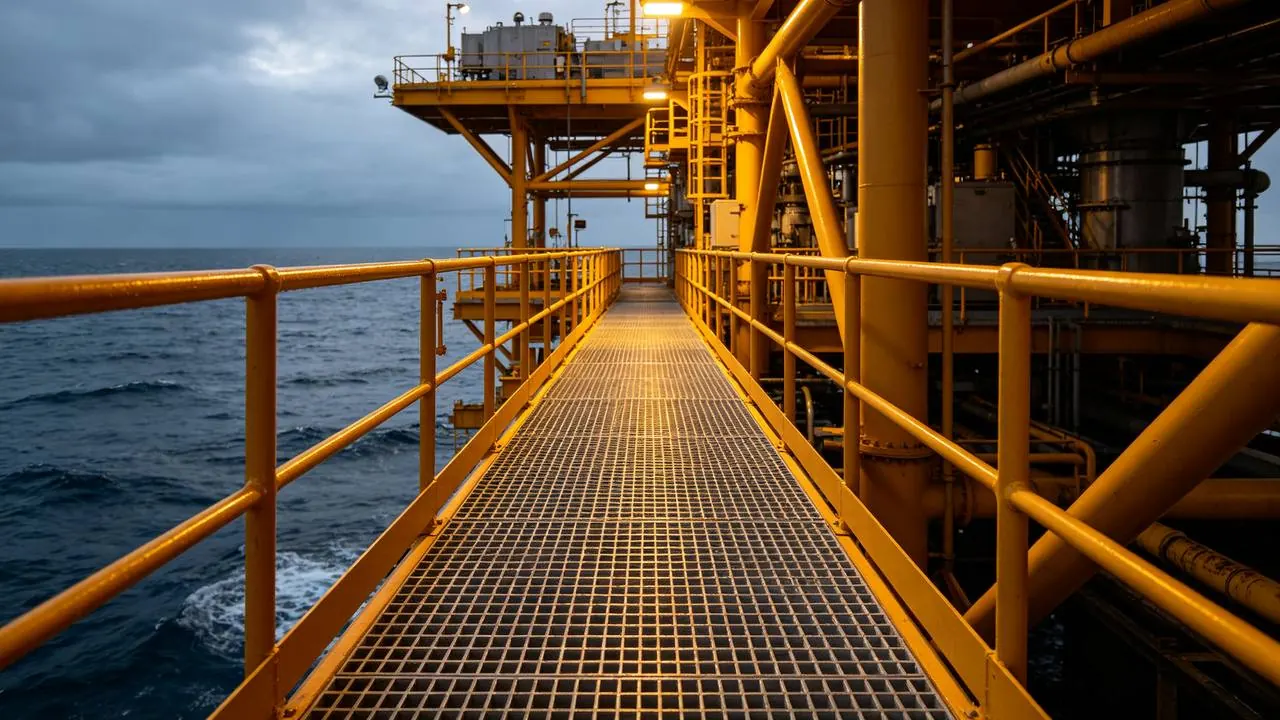
FRP grating topside decks on an offshore oil and gas production platform

Pultruded FRP walkway and handrail on an offshore drilling platform
Yellow FRP grating access walkway on an offshore oil rig
Solutions for Every Process Area
Engineered FRP solutions mapped to each stage of your facility — from corrosive process zones to high-traffic access routes.
Weight-critical topside decks and walkways with fire-retardant pultruded grating.
Structural profiles and grating for pipe rack access and cable management.
Non-conductive, spark-resistant access in process module areas.
Offshore-grade FRP stairs and ladders replacing galvanized steel.
Zero-maintenance access systems for remote and offshore structures.
Heavy-duty anti-slip molded grating and covers for wellhead, mud and drilling decks.
Technical Specifications & Compliance
Application-specific engineering reference for Oil & Gas / Offshore — corrosion rating, load criteria, governing codes and the recommended ZeAllgrate configuration. Use this as the specification starting point; final design must be verified against certified load/span charts and the project's governing codes.
| Parameter | Specification for Oil & Gas / Offshore |
|---|---|
| Corrosion Level | Severe Saltwater spray, H₂S / sour service, cathodic disbondment risk and constant UV on topside steel. |
| Typical Load Requirements | Topside pedestrian/deck 5 kN/m² (≈105 psf) minimum per offshore practice; process module & drill-floor areas higher; helideck-adjacent access rated for maintenance loads; design also accounts for dynamic wave & wind motion. |
| Applicable Standards & Regulations | ABS (Offshore Installations), DNV-OS-C101 / DNV-RP-C202, USCG (33 CFR), IMO FTP Code (Parts 2–5 flame/smoke for accommodation), API RP 2A, NORSOK N-004, OSHA 1910.29, ISO 14122. |
| Recommended Resin System | ZeAll VE for saltwater/sour service; Phenolic (or ZeAll FR) for fire/smoke-critical accommodation & escape zones per IMO FTP; UV-stabilized topcoat for exposed areas. |
| Recommended Grating Type | Pultruded I6015/T5020 for long-span topside decks (weight-critical); Molded 38.1 mm for equipment platforms & non-slip working areas; tie-bar flush-top panels at 152 mm for gangways. |
Resin systems: ZeAll VE (vinyl ester — severe corrosion), ZeAll ISO (isophthalic polyester — general service), ZeAll FDA (food/potable grade), ZeAll FR (extra flame-retardant), Phenolic (fire/smoke-critical). Grating types: Molded (bi-directional), Pultruded (long-span), Mini-Mesh (fine openings), HLC (high-load capacity).
Offshore Service Requirements
| Requirement | ZeAllgrate Response |
|---|---|
| DNV / ABS class rules | Test reports, material data and batch traceability supplied |
| Fire performance | E84 / class-equivalent data for the grade |
| Seawater & chemical splash | Vinyl ester in splash zones; SS316 hardware |
| Non-conductive / non-sparking | Inherently non-metallic construction |
Specification Guidance
Offshore access systems are specified to class rules: confirm the fire performance data and laminate properties against the DNV/ABS requirement, design the decking to the class load and deflection criteria, and supply manufacturing QC and traceability so the installed product matches the certified data. Vinyl ester resists the splash-zone chemistry; SS316 clips and base plates carry the hardware. The case library documents offshore access and helideck walkway installations.
Go Deeper with the ZeAllgrate Knowledge Base
Have a Oil & Gas / Offshore Project?
Send us your application and environment details — our engineers respond within 24 hours with a technical solution.
Offshore Platform Loading Conditions & FRP Grating Requirements
Offshore decks face loading and environmental conditions that degrade structural steel within years. ZeAllgrate FRP grating is engineered to survive the splash zone, sour service and helideck-edge loads that force repeated steel replacement.
| Condition | Steel Grating Issue | FRP Grating Advantage |
|---|---|---|
| Salt spray / splash zone | Rust, galvanic corrosion, 5-yr replacement | Immune to chloride, 25+ yr service |
| H2S / sour service | Hydrogen embrittlement | Non-conductive, no corrosion |
| Helideck edge loading | Structural steel fatigue | Glass fiber impact resistant |
| Walkway temperature cycling | Thermal expansion fatigue | Low CTE, dimensionally stable |
| MEC (Marine Environment Control) | NACE MR0175 required | Non-metallic, no MEC issue |
Resin Selection for Offshore & Marine Service
Resin choice drives fire performance, chemical resistance and total installed cost on offshore decks. Match the resin system to the zone — do not specify a general-purpose isophthalic for a helideck or accommodation escape route.
| Resin | Best Application | Flame/Smoke | Chemical Resistance | Cost Index |
|---|---|---|---|---|
| Isophthalic polyester | General walkways, splash zones | Class B/C | Good | 1.0× |
| Vinyl ester | Acid mist, chemical injection areas | Class B | Excellent | 1.5× |
| Phenolic | Helideck, accommodation modules, escape routes | Class B (E84) | Good | 2.2× |
| Phenolic vinyl ester | Ultra-high fire + chemical combo | Class A | Excellent | 2.8× |
Offshore & Marine Project References
ZeAllgrate FRP grating and access systems have been specified on offshore platforms, FPSO topsides and marine terminals worldwide. The case studies below document real retrofit projects — helideck walkway upgrades, offshore access system replacement and ferry terminal decking — with resin selection, load criteria and installation method.
North Sea platform helideck walkway upgrade
Phenolic FRP walkway panels replacing corroded steel at helideck edge, Class A flame rating per DNV.
Offshore access system retrofitting
Vinyl ester pultruded grating and handrail retrofit on a mature platform, cutting topside weight by 70%.
Ferry terminal decking replacement
Molded GRP deck panels replacing timber/steel on a marine ferry terminal, grit-covered anti-slip surface.
Buyer's Checklist for Offshore FRP Grating
Use this checklist when issuing an enquiry or tender for offshore FRP grating. Each item maps to a class requirement, a safety code or a deck-loading constraint — missing any one can force a costly re-specification at vendor qualification stage.
| Check Item | Specification | Why It Matters |
|---|---|---|
| Resin system | Phenolic or VE for splash/helideck | Fire + smoke requirements |
| Flame spread rating | ASTM E84 Class B minimum for accommodation | SOLAS / IMO FTP Code |
| Grill top surface | Grit-covered for wet anti-slip | DCOF ≥ 0.85 wet |
| Lightweight | ≤ 25 kg/m² for 38 mm | Deck loading limits |
| Non-conductive | Dielectric, no galvanic | Cathodic protection compatibility |
| Manufacturer cert | DNV / ABS / Lloyd's approved | Offshore vendor qualification |
Offshore FRP Grating — FAQs
Q: Is FRP grating suitable for offshore helideck edges?
A: Yes — phenolic FRP grating is DNV-approved for helideck edge treatment due to its Class A flame rating, low smoke emission and non-sparking properties.
Q: How long does FRP grating last in splash zone?
A: With vinyl ester or phenolic resin, FRP grating typically lasts 25+ years in the splash zone, compared to 5-8 years for galvanized steel.
Q: Does FRP grating interfere with cathodic protection?
A: No — FRP is non-conductive and does not short-circuit impressed current cathodic protection systems, unlike steel grating.
Why FRP Grating for Oil & Gas Offshore?
FRP grating for oil and gas offshore: non-sparking, non-conductive, corrosion-resistant to saltwater and hydrocarbons. Ideal for helideck edges, splash zones and walkways.